Nairobi, Kenya | 18 August 2026 — The National Assembly has invited members of the public and stakeholders to submit memoranda on the Kenya National Qualifications Framework (Amendment) Bill, 2026, as part of an ongoing public participation exercise on proposed reforms in Kenya’s education and training sector.
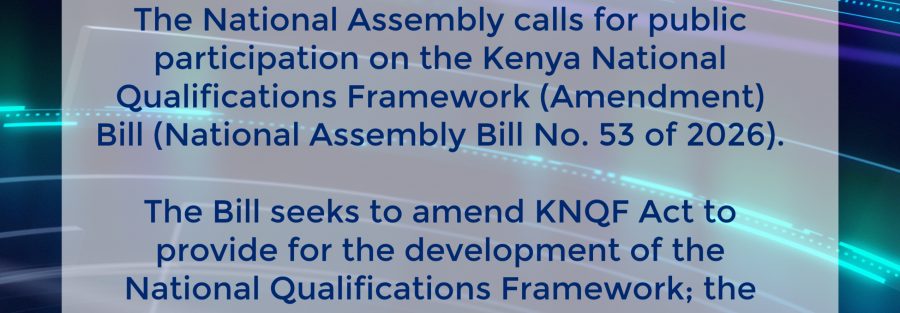
The invitation, issued by the Clerk of the National Assembly through a public notice dated 18 August 2026, covers six education and training-related Bills that have been referred to the Departmental Committee on Education for consideration and reporting to the House. The Bills include the Kenya National Qualifications Framework (Amendment) Bill, National Assembly Bill No. 53 of 2026.
The public participation exercise provides an important opportunity for stakeholders in the qualifications ecosystem, including education and training institutions, regulators, qualification-awarding bodies, professional bodies, employers, learners and members of the public, to provide views on the proposed legislative reforms.
According to the National Assembly notice, the Kenya National Qualifications Framework (Amendment) Bill, 2026, is sponsored by the Leader of the Majority Party and seeks to amend the Kenya National Qualifications Framework Act, 2014.
Among its key proposals, the Bill seeks to provide for the development of the National Qualifications Framework, the registration of qualification-awarding institutions, and the establishment of a database of national qualifications.
The proposed amendments are significant to Kenya’s qualifications landscape as they seek to strengthen the legislative framework governing the development, recognition and management of qualifications and provide a clearer statutory basis for the national qualifications information system.
The proposed establishment of a database of national qualifications is particularly relevant to efforts to enhance the integrity, traceability and accessibility of qualifications. A comprehensive national database can support the verification and authentication of qualifications while providing reliable information to institutions, employers, government agencies and other authorised users.
The Bill also proposes a more explicit framework for the registration of qualification-awarding institutions, with implications for ensuring that institutions operating within the national qualifications system meet established requirements and that qualifications are awarded within a recognised and regulated framework.
The public participation process provides an opportunity for stakeholders to assess the proposed amendments and make recommendations that can strengthen the effectiveness, clarity and implementation of the legislation.
The proposed reforms are particularly important in advancing a coherent and trusted national qualifications system. The Kenya National Qualifications Framework Act, 2014 established KNQA and assigned it functions including coordinating and supervising the development of policies on national qualifications, maintaining a national database of national qualifications, setting standards and benchmarks for qualifications and competencies, defining qualification levels, facilitating credit transfer and mobility, and establishing standards for the harmonisation and recognition of national and foreign qualifications.
The opportunity to amend the Act therefore present an opportunity to further align the statutory framework with the evolving needs of Kenya’s qualifications ecosystem and strengthen mechanisms for ensuring the credibility and portability of qualifications.
The public participation exercise will help identify areas requiring greater clarity, including the respective roles of KNQA and other sector regulators and qualification-awarding bodies, registration and compliance requirements, management and access to qualifications data, transition arrangements for existing institutions and qualifications, and mechanisms for addressing irregular, invalid or fraudulent qualifications.
The public participation process follows the constitutional principle of citizen participation in the legislative process and provides an avenue for stakeholders to contribute to reforms that have a direct bearing on the credibility, quality, recognition and mobility of qualifications in Kenya. Broad stakeholder engagement is important in ensuring that the final legislation provides a clear, effective and future-ready framework for Kenya’s national qualifications system.