


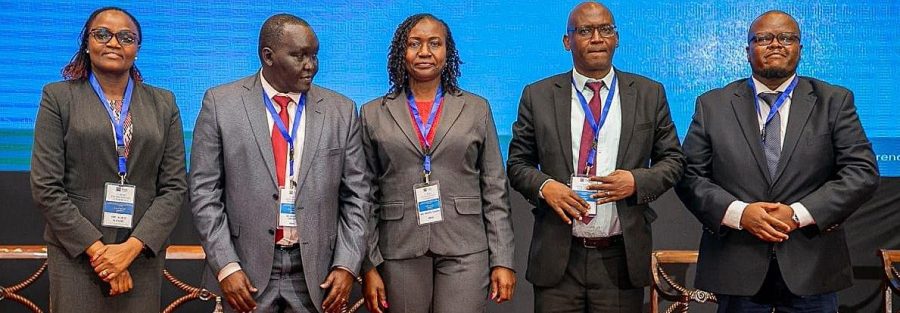
The Director General/CEO of the Kenya National Qualifications Authority (KNQA), Dr. Alice Kande, participated in the ongoing KEMI First International Conference 2026, where she joined a distinguished panel of education leaders to deliberate on the theme “Leading Curriculum Implementation – Aligning Pedagogy with Policy for Effective Learning Outcomes.”
The high-level panel brought together key stakeholders across the education and training ecosystem, including Dr. Wilson Chelimo, Director of Test Development at the Kenya National Examinations Council (KNEC); Dr. Reuben Nthamburi, Director of Teacher Professional Management at the Teachers Service Commission (TSC); and Subira Neema (HSC), Deputy Director, Secondary Education at the Kenya Institute of Curriculum Development (KICD).
In her remarks, Dr. Kande highlighted KNQA’s strategic role in strengthening the linkage between education, training, and the labour market through the implementation of the Kenya National Qualifications Framework (KNQF). She emphasized the Authority’s ongoing efforts to institutionalise Recognition of Prior Learning (RPL) as a core pillar of lifelong learning. Through RPL, competencies acquired outside formal education systems, whether in the workplace, informal sector, or through self-directed learning, are assessed, validated, and certified, enabling individuals to access formal qualifications and career progression pathways.
Dr. Kande noted that RPL is particularly significant in the Kenyan context, where a large proportion of the workforce operates within the informal sector. Integrating RPL within the KNQF and aligning it with Competency-Based Education and Training (CBET) and the Kenya Credit Accumulation and Transfer System (KCATS), will enable flexible learning pathways, reducing duplication of learning, and accelerating qualification attainment. She further highlighted the Authority’s efforts to align national qualifications with regional and continental frameworks, including the Africa Continental Qualifications Framework (ACQF), to enhance global comparability and mobility of Kenyan skills.
The panel discussion also explored practical strategies for strengthening school leadership to ensure effective curriculum implementation. Key insights included the need for school leaders to embrace instructional leadership, prioritise continuous professional development for teachers, and leverage data-driven decision-making to improve learner outcomes. The importance of aligning curriculum design, assessment systems, and classroom practice anchored within national frameworks such as the KNQF was also emphasized as critical to achieving competency-based learning outcomes.
Additionally, panelists highlighted the role of partnerships between education institutions and regulatory bodies in ensuring that education and training systems remain responsive to evolving labour market demands, including emerging sectors such as digital skills and the green economy.
The five-day conference, convened by the Kenya Education Management Institute (KEMI), aims to bridge the gap between academic knowledge and practical experience in school leadership. It provides a platform for sharing best practices, lessons learned, and innovative approaches to leadership within the education sector.
KNQA applauds KEMI for successfully convening the conference and fostering critical dialogue on the future of education leadership. The discussions and insights generated are expected to inform ongoing reforms aimed at strengthening curriculum implementation and improving learning outcomes across the country.
Building on this momentum, KNQA is preparing to host the First National Qualifications Conference scheduled for 12th–14th May. The conference will bring together key stakeholders from education, training, industry, and policy to further advance conversations on qualifications frameworks, skills recognition, quality assurance, and the alignment of education systems with the future of work. It will also provide an opportunity to deepen collaboration and reinforce KNQA’s mandate in promoting a transparent, inclusive, and globally competitive qualifications system.