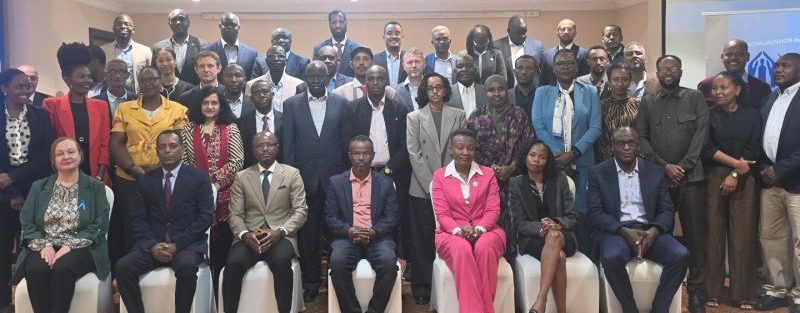
The Kenya National Qualifications Authority (KNQA) continues to show its commitment to equitable education access for displaced populations, following its participation in the 5th Intergovernmental Authority on Development (IGAD) Meeting on Refugee Inclusion in National Education Systems, held from 7th to 8th September 2026 in Addis Ababa, Ethiopia. The high-level gathering brought together IGAD Member States, the United Nations High Commissioner for Refugees (UNHCR), ministries responsible for education and refugee affairs, development partners, civil society organizations, and refugee-led groups, all working toward more cohesive strategies for integrating refugees into national learning systems across the region.
Refugee inclusion in education remains one of the most pressing challenges facing the IGAD region, which hosts some of the largest displaced populations in Africa. For many refugees, years spent outside formal education systems create significant barriers to re-entry, leaving valuable skills and knowledge unrecognized and underutilized. It is against this backdrop that KNQA’s contributions at the meeting carried particular weight, offering a practical model for how national qualifications systems can open doors rather than close them.
At the heart of KNQA’s approach is the Recognition of Prior Learning (RPL) framework, a mechanism that formally assesses and certifies skills and competencies acquired outside conventional classrooms. For refugees, whose educational journeys are often disrupted by displacement, RPL offers a vital bridge back into structured learning and economic participation. Rather than requiring individuals to start from scratch, the framework recognizes what they already know and can do, translating lived experience and informal training into recognized qualifications. This, in turn, opens legitimate pathways for refugees to resume their education, enroll in technical and vocational training, or move directly into the labor market.
The impact of this approach extends beyond the individual. Enabling refugees to validate and apply their skills fosters a two-way exchange of knowledge and capability between displaced populations and host communities, strengthening social cohesion and contributing to shared economic growth.
This aligns closely with the broader objectives discussed in Addis Ababa, where participants emphasized that meaningful refugee inclusion requires national systems flexible enough to accommodate diverse and non-linear learning journeys.
Kenya’s continued engagement in these regional dialogues reinforces its standing as a leader in sustainable displacement response within the IGAD bloc. Through its adaptive and inclusive national qualifications framework, KNQA is demonstrating how institutional systems can evolve in step with the changing needs of displaced communities, rather than treating displacement as an exception to be managed outside the mainstream education architecture.
Looking ahead, KNQA has signaled its continued resolve to advance lifelong learning opportunities, uphold the dignity of skills recognition, and build a responsive education ecosystem grounded in the principle that no learner should be left behind, whether displaced or otherwise. As regional partners work to translate the outcomes of the Addis Ababa meeting into concrete national actions, KNQA’s RPL model stands out as a tested framework that other IGAD member states may look to as they design their own pathways toward refugee inclusion.